
ServiceNow AI Governance: Where Ellaworks Fits
See how ServiceNow AI Control Tower, AI Gateway, and Now Assist work alongside Ellaworks to govern enterprise AI across platforms, agents, and teams.
Quick summary
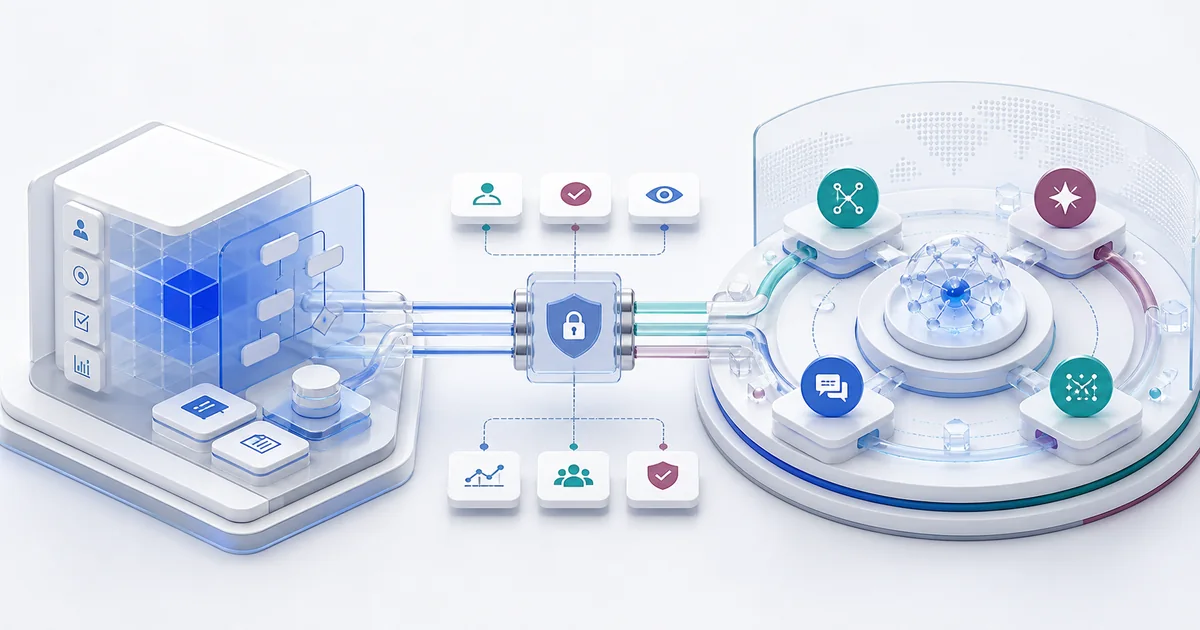
ServiceNow has developed a broad native governance system for its AI platform. AI Control Tower provides centralized visibility and control across AI assets, AI Gateway governs Model Context Protocol transactions, and Now Assist applies layered security controls to agentic workflows.
Ellaworks gives enterprises a complementary operating foundation for the AI estate beyond any single platform. It connects agents, models, tools, and enterprise systems through an open architecture, applies governance at the inputs, maintains a secure agent directory, and turns AI activity into business intelligence. Ellavox engineers help implement and support that operating model in production.
Together, these capabilities give enterprise teams a practical way to use ServiceNow within a broader, governed AI strategy.
What ServiceNow already provides for AI governance
ServiceNow’s current AI governance portfolio is more extensive than a basic agent catalog. Its official documentation describes several connected capabilities.
AI Control Tower
AI Control Tower supports governance of enterprise and ServiceNow AI assets. ServiceNow describes the platform as a central place to discover, observe, govern, secure, and measure AI systems, agents, models, and workflows.
Its asset discovery process can synchronize models, datasets, prompts, skills, and agentic AI components into an AI asset inventory. For organizations already operating ServiceNow as a system of action, this creates a valuable connection between AI oversight and existing workflow, risk, and service-management processes.
AI Gateway
AI Gateway provides lifecycle management, asset registration, authentication, observability, and policy controls for MCP transactions. It is designed to work with ServiceNow and external agentic studios and hosts.
This matters because agentic systems increasingly need controlled access to tools and enterprise data. MCP makes those connections easier; an enterprise gateway makes the connections governable.
Now Assist security and agent controls
ServiceNow’s agentic AI security model combines access controls, agent identities, role masking, data protection, runtime safeguards, and activity logs. Now Assist Guardian can monitor prompts and responses for prompt injection, sensitive subjects, and other risks.
ServiceNow also documents a structured lifecycle for teams to plan, build, secure, test, deploy, and monitor AI agents in AI Agent Studio.
The enterprise challenge extends across platforms
Most large enterprises will operate more than one AI environment. ServiceNow may manage important workflows while other agents run in cloud platforms, contact centers, business applications, custom runtimes, and emerging AI tools.
That creates an operating question larger than any one integration:
How does the enterprise apply a consistent operating model to every AI worker while allowing teams to use the technologies best suited to the job?
The answer requires visibility, identity, ownership, permissions, approvals, data controls, and measurable outcomes across the full AI estate.
How Ellaworks complements a ServiceNow environment
Ellaworks brings five connected capabilities to that broader operating model.
1. Open connectivity
Ellaworks connects the runtimes, models, tools, and systems the enterprise chooses. ServiceNow can remain a critical workflow and system-of-action layer while Ellaworks provides a consistent connection pattern across other environments.
This open architecture gives teams room to adopt new capabilities without rebuilding the operating model for every vendor.
2. Governed execution
Governance begins with the worker’s role, objective, information, tools, authority, budget, and required approvals. These controls establish the conditions under which an AI worker may act.
For ServiceNow-centered workflows, that can mean aligning an agent’s operating charter with existing access controls, workflow approvals, and risk policies before it performs production work.
3. Secure agent identity
The Secure Agent Directory records which agents exist, who owns them, where they operate, how they are configured, what they can access, and which people or systems may interact with them.
This identity layer helps connect internal and external agents to a common enterprise operating model.
4. Business intelligence from AI activity
Technical traces are essential, but leadership also needs to know what the AI workforce is delivering. Ellaworks turns agent activity into measurable outcomes, critical insights, and performance over time.
Every agentic worker produces intelligence that can inform what the organization does next. That intelligence remains controlled by the enterprise.
5. Ellavox engineering support
Ellavox engineers help customers implement integrations, establish governance, deliver the first production use cases, and support the operating platform. This service model helps teams move from architecture to dependable production operations.
A practical implementation sequence
A ServiceNow and Ellaworks implementation can begin with one high-value workflow rather than a broad platform migration.
- Define the business outcome. Identify a workflow where an AI worker can improve speed, quality, capacity, or customer experience.
- Map the operating environment. Record the ServiceNow workflows, models, tools, data, identities, and external systems involved.
- Establish the worker’s controls. Define its objective, permitted actions, access, budget, approval points, and escalation path.
- Connect the systems. Integrate ServiceNow with the selected models, runtimes, and supporting enterprise tools.
- Deploy with observability. Monitor behavior, technical execution, and measurable business outcomes.
- Improve and expand. Use production intelligence to refine the worker and apply the operating model to the next use case.
Questions enterprise teams should ask
Before scaling AI across ServiceNow and other platforms, evaluate the operating model with a few concrete questions:
- Can we identify every agent and its owner?
- Do we know which tools, data, models, and budgets each worker may use?
- Are human approvals placed at the actions that actually require them?
- Can we trace the configuration and policy that governed a production decision?
- Can business leaders see outcomes alongside technical activity?
- Can we add a new runtime or model without rebuilding governance from the beginning?
Clear answers indicate that the organization is building an AI operating capability, rather than a collection of isolated implementations.
Build a governed ServiceNow AI operating model
ServiceNow supplies powerful native controls for AI assets, workflows, MCP connections, and agentic operations. Ellaworks helps carry that discipline across the wider enterprise AI estate while adding an open service platform and an experienced implementation team.
Talk with Ellavox about your ServiceNow and enterprise AI environment.