
Prompt Management for Production AI Agents
A practical framework for managing prompts as governed production assets across agents, environments, teams, tools, and models.
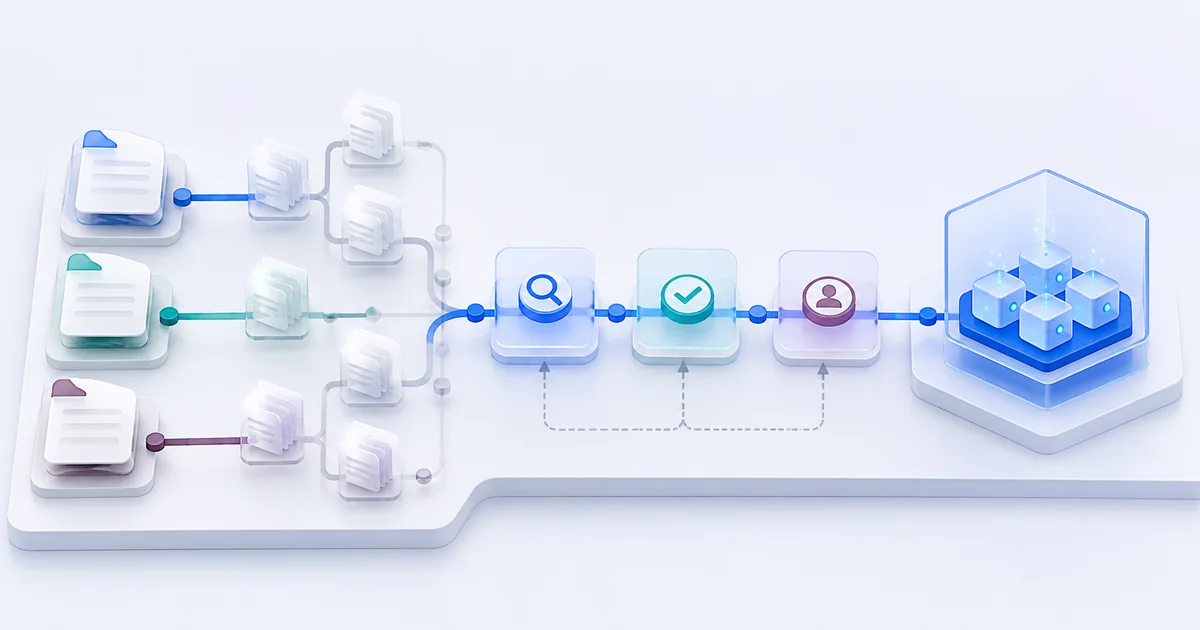
Prompt management is the discipline of controlling the instructions that shape an AI system’s behavior throughout its production lifecycle.
Prompts often begin as flexible working material. A team experiments in a model interface, shares an effective version in a document, and copies it into an application. That can be enough for a prototype. It becomes fragile when the same instructions are reused across agents, environments, customers, and business processes.
Production prompt management creates a trusted answer to a simple question: what instructions are governing this AI worker right now?
Why prompts become an operational problem
A prompt is part of an agent’s production configuration. It works alongside tools, permissions, models, data, budgets, and approval rules to influence what the system may do.
When prompts are scattered, common problems follow:
- teams cannot identify the approved version with confidence;
- changes reach production without a consistent review process;
- the same instruction is copied into multiple systems and drifts over time;
- business owners cannot see who is responsible for a prompt;
- operators struggle to connect a behavior change to the instructions that caused it;
- rollback depends on finding an older copy and rebuilding context manually.
The challenge is larger than storing text. Enterprises need a controlled lifecycle around that text.
The production prompt lifecycle
Define purpose and ownership
Every prompt should belong to a named worker, use case, or operating role. Its owner should be clear to the business and technology teams responsible for the outcome.
Purpose provides the context needed to evaluate quality. A prompt cannot be judged only by whether it produces fluent output. It should be judged by whether it helps the worker perform its assigned job within the required boundaries.
Build from governed inputs
The inputs to an AI worker include more than its primary instruction. Teams should define:
- the information the worker may use;
- the tools and systems it may call;
- the model or runtime available to it;
- the authority and spending limits attached to its role;
- prohibited actions and escalation conditions;
- the decisions that require human approval.
Managing these inputs together makes the prompt part of an operating system instead of an isolated artifact.
Version every meaningful change
A production prompt should have a recorded version and change history. The record should make it possible to understand what changed, who changed it, why it changed, and where that version is active.
Versioning supports safer iteration. Teams can compare outcomes across releases, investigate unexpected behavior, and return to a known configuration when necessary.
Review and approve before release
Approval should follow the risk and role of the worker. A low-impact internal assistant may require a lightweight review. An agent that can commit funds, alter customer records, or communicate externally may require explicit business and technology approval.
The workflow should capture the decision rather than relying on a conversation that disappears after deployment.
Observe behavior and outcomes
Prompt management continues after release. Teams need to see whether the worker is following its role, where exceptions occur, and whether the intended business result is improving.
Behavioral observability connects the configuration that was approved to the work that actually happened. Business outcome visibility shows whether the change created value.
Improve with retained intelligence
Every execution can reveal something about customer needs, process friction, failure patterns, and effective next actions. That intelligence should remain available to the enterprise and inform future versions.
The result is a controlled learning cycle: build, approve, operate, observe, and improve.
What a prompt management platform should provide
An enterprise prompt management capability should connect the full lifecycle rather than solving one isolated step.
Look for:
- a central record of prompts, workers, owners, and deployments;
- permissions appropriate to different roles and business units;
- version and change history across environments;
- policies and approval workflows attached to production actions;
- visibility into model, tool, and system access;
- activity records that connect configuration to behavior;
- business-facing views of outcomes and exceptions;
- open integrations that avoid dependence on one AI provider;
- options that keep enterprise data and intelligence under enterprise control.
The system should also support the people using it. Business leaders, CIOs, CISOs, CTOs, operators, integrators, and developers need different views of the same governed environment.
Prompt management and AI governance
Prompt management is a core part of AI governance, but it is not the whole system.
Governance also includes agent identity, ownership, access, tools, budgets, approvals, activity history, data protection, and measurable outcomes. Managing prompts inside that wider context creates stronger controls because teams can connect an instruction to the worker using it and the work it produced.
That connection is especially important as enterprises adopt AI from many sources. Some agents will be built internally. Others will arrive inside existing applications or from external providers. A common operating layer allows the enterprise to apply consistent expectations across them.
A practical way to begin
Start with one meaningful production workflow. Document the worker’s role, owner, inputs, tools, permissions, approval points, and desired outcome. Establish the first approved configuration, then observe what happens in production.
This creates a real governance pattern that can be repeated. It also reveals where the organization needs tighter controls, better integrations, or clearer business ownership before expanding to more use cases.
Ellaworks provides that operating foundation. It brings governed execution, secure agent identity, approval workflows, behavioral observability, open integrations, private AI options, and business intelligence into one enterprise service platform. Ellavox can implement the first use case with your team and support the system as it scales.