
What Is an AI Control Plane?
A clear guide to the operating layer that connects governance, identity, integrations, observability, and business intelligence for enterprise AI.
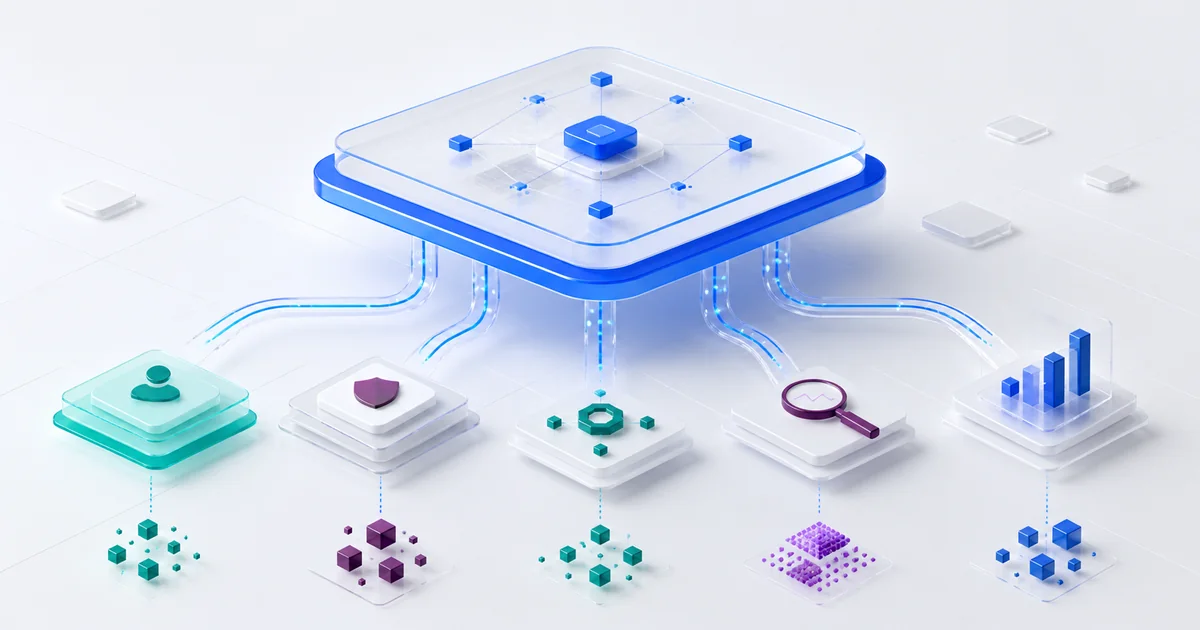
An AI control plane is the operating layer an enterprise uses to manage how AI systems are built, authorized, connected, deployed, observed, and improved.
The term describes a shared management foundation rather than a particular model or agent runtime. Models generate. Runtimes execute. Business applications provide context and tools. The control plane connects those choices to enterprise policy, ownership, accountability, and outcomes.
Why enterprises need a common operating layer
AI adoption rarely follows one clean technology path. Teams select different models for different jobs. Business applications introduce copilots and agents. Integrators build custom workflows. New tools enter the market continuously.
That variety can be valuable, but it creates an operating challenge. Without a common layer, each system brings its own permissions, records, monitoring, and deployment process. The enterprise has to reconstruct a complete picture across disconnected tools.
An AI control plane provides a consistent place to answer:
- Which agents, models, copilots, and AI applications are in use?
- Who owns each system and what role does it perform?
- Which tools, data, authority, and budget may it use?
- Which actions require approval?
- What is happening in production?
- What business result is the AI workforce delivering?
- What intelligence should improve the next decision or version?
The four layers of an enterprise AI control plane
Intelligence
The intelligence layer turns AI activity into a business-facing operating view. It should surface measurable outcomes, critical insights, exceptions, and performance over time.
This layer helps leaders understand what the AI workforce is delivering. It gives operators a place to identify where intervention or iteration is needed.
Governed operations
The operating layer is where workers are created and controlled. It connects the worker’s role to its instructions, policies, permissions, budgets, approval workflows, version history, and behavioral observability.
Governance begins at the inputs. The enterprise establishes what a worker may do before that worker acts, then retains the production evidence required to understand its behavior.
Secure connectivity
The connectivity layer links agents to models, runtimes, tools, enterprise systems, and other agents. A secure directory provides identity, discovery, ownership, configuration, access, and trust.
Open architecture is critical. The enterprise should be able to use different technologies without creating a new governance model for every stack.
Protected foundation
The foundation keeps enterprise data, policies, budgets, and intellectual property under enterprise control. Private AI options can help organizations safeguard the knowledge and intelligence their systems create.
This layer should feel stable even while the technologies connected above it continue to change.
How a control plane differs from adjacent tools
Agent builders
An agent builder helps create a worker or workflow. A control plane manages the wider lifecycle and operating environment around that worker, including identity, governance, connection, visibility, and improvement.
Model platforms and runtimes
A model platform supplies intelligence or execution infrastructure. A control plane allows the enterprise to coordinate multiple providers and apply consistent operating requirements across them.
Observability tools
Observability tools reveal behavior, traces, cost, and performance. A control plane connects that evidence to the worker’s approved role, authority, configuration, and business outcome.
Governance policy tools
Policy tools help define expectations and document risk. A control plane carries those expectations into production workflows through permissions, approvals, activity history, and operational visibility.
The categories can overlap. The important question is whether the enterprise has one connected way to move from policy and design to production behavior and measurable results.
What to look for in an AI control plane
The strongest platform will be useful to both the teams operating AI and the leaders accountable for its impact.
Evaluate whether it provides:
- one record of agents, owners, roles, and deployments;
- governed inputs, tools, permissions, and budgets;
- human approvals at defined moments;
- version and activity history;
- behavioral observability and business outcome visibility;
- secure connections across internal and external agents;
- integration with multiple models, runtimes, tools, and enterprise systems;
- private AI and data-sovereignty options;
- an implementation and support model suited to the organization.
The final point matters. A control plane may provide the right architecture while the enterprise still needs help selecting a first use case, connecting systems, defining controls, and establishing an operating process.
From control plane to service platform
Ellaworks applies the control-plane model as an enterprise AI service platform. It brings the intelligence, operating, connectivity, and protected-foundation layers together, with Ellavox engineering support around the complete system.
This makes two things possible at once. The technology environment remains open enough to adopt the models and tools best suited to the work. The operating environment remains controlled enough to protect data, budgets, intellectual property, and accountability.
The platform has been shaped by production experience. Ellavox and its customers use Ellaworks to support AI at enterprise scale, and every execution can contribute durable intelligence that the enterprise owns.
A useful starting question
Before selecting another AI tool, ask whether the organization can explain how that tool will be owned, authorized, connected, observed, and improved after it enters production.
If the answers live in different systems or depend on a few people remembering them, a common operating layer can reduce fragmentation and create a safer path to scale.