
How to Manage AI Agents in Production
A practical operating model for building, governing, connecting, observing, and improving AI agents across the enterprise.
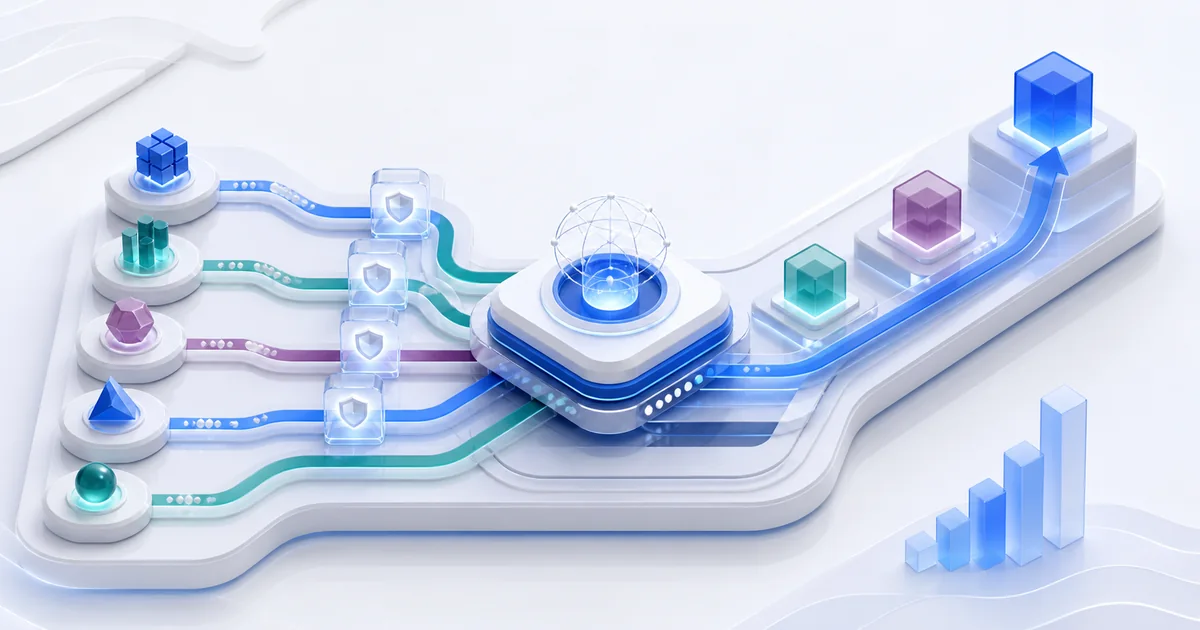
Managing AI agents in production requires more than a builder and a dashboard. Enterprises need a connected way to create workers, define their authority, discover where they operate, monitor their behavior, and improve the outcomes they produce.
The operating model matters because agents do not stay isolated for long. A successful pilot becomes several workflows. Business units adopt different models and tools. Vendors introduce agents inside existing applications. Soon the organization has a growing AI workforce without a consistent way to manage it.
Why agent management becomes difficult at scale
The first agent is usually understood by the people who built it. They know its purpose, prompt, tools, and limitations. That context becomes harder to preserve as the environment grows.
Without a shared operating foundation, teams encounter familiar gaps:
- no complete directory of the agents deployed across the enterprise;
- unclear ownership when an agent behaves unexpectedly;
- inconsistent permissions, budgets, and approval rules;
- different control models for every runtime or provider;
- limited visibility into whether workers are delivering business value;
- intelligence trapped inside separate tools and applications.
These are lifecycle problems. Solving them requires the stages of agent operations to work together.
Five responsibilities of production agent management
1. Build the worker around a clear role
An agent should begin with a defined job. The role establishes the business objective, the information available to the worker, the systems it may use, and the outcome by which its work will be judged.
Clear roles make agents easier to test and operate. They also give business owners a concrete way to participate in design rather than treating the worker as an abstract technical system.
2. Govern authority before the first action
Each worker should receive only the permissions, tools, data, and budget required for its role. Policies should define prohibited actions and the moments when a person must approve the next step.
This is governed execution. It places control in the work itself instead of depending on a review after the fact.
3. Connect the agent to the enterprise
Agents create value by working with business systems, models, tools, and other agents. Those connections need a secure identity and a trusted record of ownership and access.
A secure agent directory should show:
- which agents exist and where they are deployed;
- who created and owns each one;
- how each agent is configured;
- which resources it may access;
- who or what may interact with it.
Open integrations allow enterprises to connect the technologies best suited to each use case without recreating the management layer for every provider.
4. Operate with behavioral and business visibility
Production visibility should answer both technical and business questions.
Technology teams need to see execution history, exceptions, approvals, configuration, and access. Business leaders need to know what work was completed, what outcome changed, and where the system needs attention.
Combining these views makes it possible to connect agent behavior to measurable results.
5. Improve the system over time
Every execution can produce useful operational intelligence. Teams can learn which requests are common, where processes break down, which decisions create delay, and which worker configurations produce better outcomes.
That intelligence should remain under enterprise control and inform the next version of the worker. Improvement then becomes part of the operating loop rather than a separate analytics project.
The capabilities an agent management platform needs
A production platform should support the whole environment, including agents built inside the platform and agents introduced through other tools.
Core capabilities include:
- an autonomous agent builder;
- governance at the inputs;
- policies, permissions, and budget controls;
- human approval workflows;
- version and activity history;
- behavioral observability;
- a secure directory for internal and external agents;
- connections to models, runtimes, tools, and enterprise systems;
- a customizable portal for outcomes and critical insights;
- private AI and data-sovereignty options;
- engineering support for implementation and operation.
The platform should remain open by design. AI technology will continue to change, and the enterprise needs a durable operating layer that can adapt without surrendering governance or intelligence.
A shared platform serves different teams
Agent management is an enterprise responsibility, not a single-department tool.
Business leaders need a practical way to move from a valuable use case to a production outcome within budget.
CIOs, CISOs, and CTOs need visibility into identity, access, data, behavior, ownership, and change while giving the business room to innovate.
Integrators and consultants need an open foundation that can work across client technologies while preserving governance and trust.
A connected platform gives each audience the view it needs without fragmenting the underlying system.
Start with a production use case
The best place to begin is a real workflow with a clear owner and measurable result. Define the worker’s role, connect the necessary systems, establish approvals and limits, and operate it with full visibility.
Once that foundation works, the enterprise can reuse the pattern across additional workers and business units.
Ellaworks is built for that progression. It is an open, governed service platform for enterprise AI, supported by Ellavox engineers with production managed-services experience. Customers can ask Ellavox to operate the capability, build the first use case together, or adapt the implementation around another approach.